A weeks-long, violent crackdown on protesters in Iran has eased. Though dissent no doubt remains, an Internet blackout has made it hard to know exactly what’s happening. Still, the recent clashes drew international attention, again, to the harsh realities for Iranians.
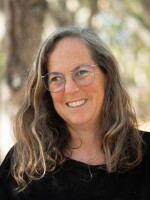
Cal State Monterey Bay lecturer and writer Ava Homa has family in Iran. She spoke only briefly with them during the recent protests. Then also with a relative who returned to the United States from Tehran. She spoke with KAZU’s Amy Mayer about what was different this time.
This interview has been edited for length and clarity.
Ava Homa: [My relatives] have been a part of almost every uprising for the past couple of decades. So they were very shocked by both the large number of people that attended the protest, as well as the type of background. You would usually see younger, politically active people on the streets. This time, [my relative who was in Tehran and then returned to the United States] witnessed families with grandparents and young children, and even a visibly pregnant woman.
So, that was one of the main things that he pointed out. It was as if, for a second, both people were stunned by the large population as well as the government itself, completely unexpectedly. Because this last uprising was a response to a call by the son of the former King of Iran. And, people haven't been really responding to that call because a large population are against bringing monarchy back, considering it a step backwards. However, the situation has become so dire, just in the past couple of years, with the economy getting more unstable and with the pressure that the Iranian government put on its [people] after Israel's attack on Iran, that it has created a depth of exhaustion and desperation where people are changing what they're asking for. Because obviously in times of crisis, relief is the first thing that we reach for.
Amy Mayer: How has observing the situation, from your position here in the U.S., been different this time, compared to what you've witnessed from abroad in other times?
AH: I understand that as an exiled writer, my safety here is both a privilege as well as a responsibility, and I am trying to do my best to amplify the voices of people within Iran without judgment or imposing my own political ideologies on them. For example, I'm very much scared by this call for foreign intervention and the return of the monarchy. I consider it as this short-term solution that can, in the long run, reproduce oppression by creating these national hierarchies and ethnic hierarchies that the king of Iran imposed. However, being here, I try to faithfully amplify their voices regardless of what my beliefs are. And I have noticed that as a Kurdish-Iranian woman, it matters to me how women respond and react in each protest. It matters to me how ethnic groups respond to each protest. So I try to make sure it's clear that, you know, the way Kurds responded to previous uprising is different because Kurds and other [minority] ethnic groups are more afraid of the monarchy than the Persians are, which is why this time you see a larger population taking the street in big cities like Mashhad or Tehran versus more regional and marginalized ethnic groups that tend to live on the border between Iran and other countries. So there is a lot of complexity and nuance that I have to deal with constantly.
The other thing that has changed is the causes, the slogans. So initially, people came to the streets asking for freedom and dignity. But this time, with the economy, with the Iranian currency being so incredibly devalued, once stable middle-class families are now struggling to feed their children. So this economic grievance has created a universal response among different classes, but not among different ethnic groups.
AM: What would you like to leave people with?
AH: I think it's very important for us to remember that what is happening in Iran is part of the global pattern, and how we respond to oppression in Minnesota, in Gaza, in Ukraine, they're all connected. But, basically, how you respond to oppression anywhere sets the precedent for what unfolds.
CSUMB holds the broadcast license for KAZU.